
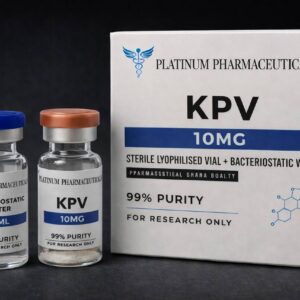
KPV is a synthetic tripeptide consisting of the C-terminal amino acid sequence of alpha-melanocyte-stimulating hormone (α-MSH): Lys-Pro-Val. It represents the minimal active fragment of α-MSH with anti-inflammatory activity, and has been studied for its effects on inflammatory pathways in multiple preclinical models — particularly in the context of gastrointestinal inflammation, dermal inflammation, and systemic anti-inflammatory signalling.
What Is KPV?
Alpha-MSH (α-MSH) is an endogenous 13-amino acid peptide derived from POMC (pro-opiomelanocortin) with well-documented anti-inflammatory properties. Its C-terminal tripeptide KPV (Lys-Pro-Val, positions 11–13) was identified as the minimal sequence retaining the anti-inflammatory activity of the parent molecule — making it one of the most studied short-sequence bioactive peptides in inflammation research.
KPV’s small size (three amino acids) confers advantages in preclinical research: it is resistant to many forms of enzymatic degradation, stable across a range of pH conditions, and has been studied in both systemic and oral administration models — the latter being unusual for peptides, which are typically degraded in the gastrointestinal tract before absorption.
KPV Research Background
Gastrointestinal inflammation: KPV has been extensively studied in preclinical models of intestinal inflammation. Research published in Gastroenterology and Journal of Pharmacology and Experimental Therapeutics has examined KPV’s effects in rodent models of colitis, documenting reductions in pro-inflammatory cytokines (TNF-α, IL-6, IL-1β) and inflammatory scoring in colonic tissue. The oral stability of KPV has made it of particular interest for GI-targeted research applications.
Melanocortin receptor pathway: KPV exerts its anti-inflammatory effects primarily through melanocortin receptor interactions, particularly MC1R and MC3R, and through direct inhibitory effects on NF-κB activation — a master regulator of inflammatory gene transcription. This dual mechanism distinguishes KPV from compounds that act solely through receptor-mediated pathways.
Dermal inflammation research: Studies have examined KPV in models of skin inflammation, including contact dermatitis and psoriasis models, documenting anti-inflammatory effects when applied topically or administered systemically in rodent models.
BPC-157 combination research: KPV and BPC-157 are sometimes co-studied in gastrointestinal inflammation research given their complementary mechanisms — BPC-157 acting on NO pathways and tissue repair, KPV on NF-κB and melanocortin anti-inflammatory pathways.
Reconstitution Guidelines (Research Use)
KPV is supplied as lyophilised powder. Reconstitute with bacteriostatic water or sterile saline.
Recommended concentration: 1mg/ml.
For precise volume calculations: Peptide Reconstitution Calculator
Storage
- Lyophilised powder: 2–8°C, protected from light
- Reconstituted: 2–8°C, use within 28 days
- Long-term: -20°C
- KPV is notably stable compared to larger peptides — good shelf life when stored correctly
VITALITY CARTEL KPV
99%+ purity, third-party HPLC verified. CoA available on request. Available in 10mg vials. Domestic AU dispatch.
Reviews
There are no reviews yet.