
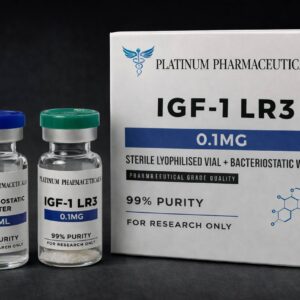
IGF-1 LR3 (Long R3 Insulin-like Growth Factor-1) is a synthetic, elongated analogue of human IGF-1, engineered with an arginine substitution at position 3 and a 13-amino acid N-terminal extension. These modifications reduce its binding affinity to IGF-binding proteins (IGFBPs) by over 1,000-fold relative to native IGF-1, dramatically extending its plasma half-life from minutes to approximately 20–30 hours and increasing its bioavailability for research applications.
What Is IGF-1 LR3?
Native IGF-1 (Insulin-like Growth Factor 1) is a 70-amino acid peptide produced primarily in the liver in response to growth hormone signalling. It is the primary mediator of GH’s anabolic and growth-promoting effects, acting on IGF-1 receptors (IGF-1R) expressed in virtually every tissue in the body. IGF-1 LR3 was developed to extend the research utility of IGF-1 by bypassing the rapid sequestration by IGFBPs that limits native IGF-1’s activity window.
IGF-1 LR3 Research Background
Cellular growth and proliferation: IGF-1R activation stimulates downstream PI3K/Akt and MAPK/ERK signalling pathways — two of the most studied intracellular cascades governing cell growth, proliferation, protein synthesis, and survival. Research in cell culture and animal models has extensively characterised IGF-1 LR3’s potency as an IGF-1R agonist.
Muscle biology research: Animal studies have examined IGF-1 LR3’s effects on skeletal muscle hypertrophy, satellite cell activation, and myofibrillar protein synthesis. Research has documented dose-dependent increases in muscle mass in rodent models, with IGF-1 LR3 used as a reference compound in muscle biology research for its consistent, reproducible activity.
Bone and connective tissue: IGF-1 signalling is critical for longitudinal bone growth and bone mineral density. Research has examined IGF-1 LR3’s effects on osteoblast differentiation, collagen synthesis, and bone formation in animal models.
Metabolic research: IGF-1 shares structural homology with insulin and exerts insulin-like effects on glucose metabolism. Research protocols examine IGF-1 LR3’s effects on glucose uptake, lipid metabolism, and insulin sensitivity in preclinical models.
Research note: IGF-1 LR3’s extended half-life and reduced IGFBP binding make it the preferred IGF-1 analogue for most research applications requiring sustained IGF-1R activity. IGF-1 DES is preferred for research requiring enhanced potency at specific tissue sites.
Reconstitution Guidelines (Research Use)
⚠️ IGF-1 LR3 requires different reconstitution to all other peptides.
Reconstitute in 0.1% acetic acid first, then dilute to working concentration with sterile saline or bacteriostatic water. Do NOT use BAC water alone — the peptide will not dissolve correctly.
Recommended concentration: 0.1mg/ml to 0.5mg/ml.
Peptide Reconstitution Calculator
Storage
- Lyophilised powder: -20°C (more thermally sensitive than most peptides — do not store at 4°C long-term)
- Reconstituted: 2–8°C, use within 14 days
- Highly sensitive to degradation — avoid repeated freeze-thaw cycles
99%+ purity, HPLC verified. CoA available on request. Domestic AU dispatch.
Reviews
There are no reviews yet.